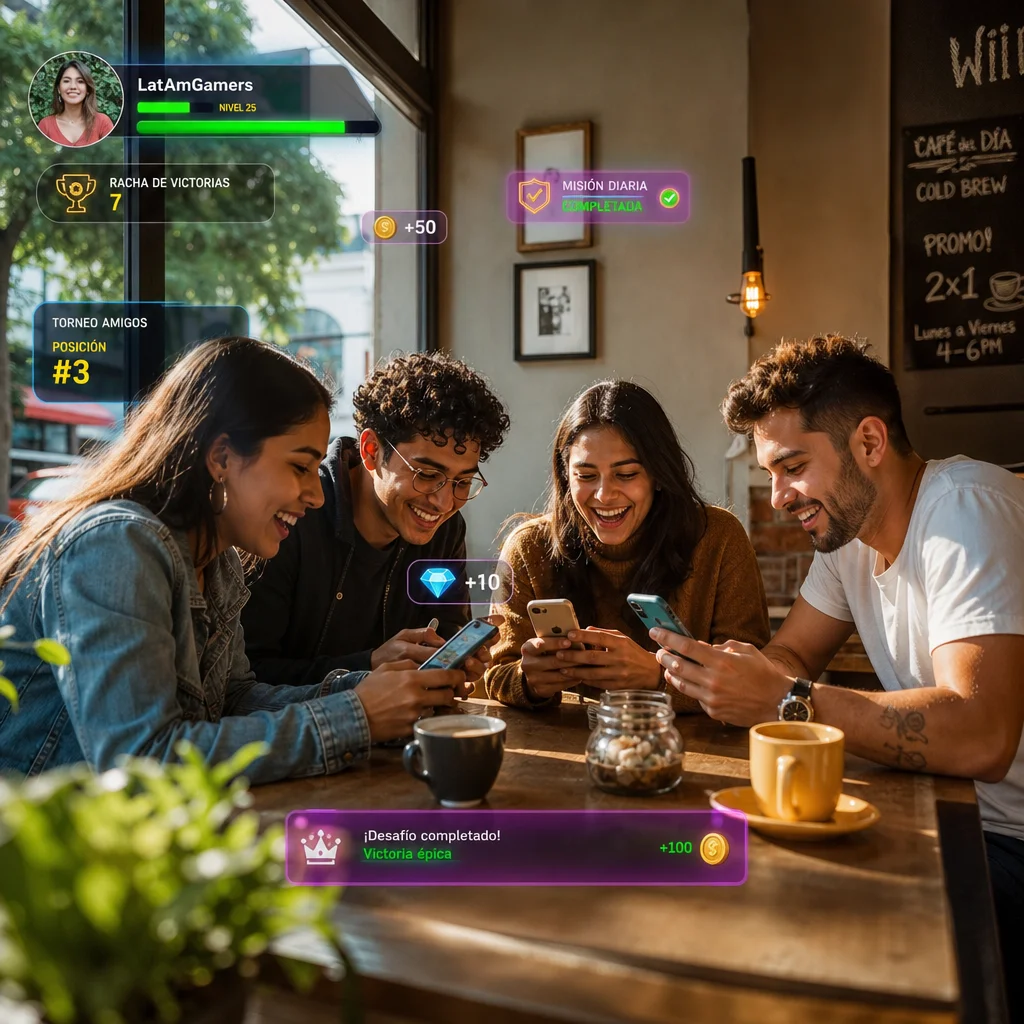
Online leisure in Latin America has transformed faster over the last five years than it did across the preceding two decades. The clearest indicator of this structural shift is the quiet, sustained surge of themed games. These are rarely the massive blockbuster releases that dominate global desktop and console sales charts. Instead, they are agile, culturally resonant experiences built around instantly recognizable motifs: a passionate football club rivalry, a classic telenovela storyline, a vibrant regional festival, or the bustling energy of a neighborhood street market. They have secured a fiercely loyal, daily-active audience spanning Mexico, Brazil, Colombia, Argentina, and Chile. What first appeared to be a fleeting niche curiosity now serves as a masterclass in understanding how millions of urban Latin Americans choose to spend their digital free time.
This ongoing evolution extends far beyond the types of titles being downloaded. It fundamentally alters when users play, on which devices, alongside whom, and what expectations they bring to the table. Modern Latin American gamers demand experiences that are deeply local, frictionlessly mobile, and inherently social—and the development studios that decode these shifting priorities are the ones capturing market share.
A Region That Plays Differently
Latin America’s demographic profile is remarkably young, highly urbanized, and digitally tethered. A significant majority of the population is under thirty-five. For most individuals within this demographic, a smartphone was not merely an upgrade; it was the very first personal computing device they ever owned. This single reality reshapes the entire leisure ecosystem.
Traditional desktop gaming habits never had time to sink deep roots, allowing the region to bypass several transitional phases experienced by older digital markets. Users didn’t migrate sequentially from high-end consoles to handheld screens; for millions, the mobile device was the starting line. Consequently, the regional leisure culture is flexible, opportunistic, and intensely social. Games must compete directly with short-form video platforms, instant messaging groups, and streaming series. They only win this fierce battle for attention by seamlessly integrating into the micro-gaps of a busy working day: a crowded metro commute, a hasty lunch break, or a ten-minute wait in a bureaucratic queue. Themed games fit these fleeting windows with absolute precision.
Mobile First Means Session First
Designing for Latin America requires engineering for extreme technical fragmentation. Gaming sessions are typically brief—often lasting under four minutes—and prone to frequent interruptions. A title demanding sustained concentration or an uninterrupted, high-speed broadband connection will quickly hemorrhage users who rely on prepaid mobile data plans or mid-range devices with constrained internal storage.
Successful themed titles are therefore meticulously optimized: they boot instantly, tolerate intermittent cellular connectivity, and deliver a rewarding gameplay loop within a single short visit. This technical constraint heavily dictates user interface (UI) architecture. Interactive buttons are positioned within easy thumb reach along the lower quadrants of the screen, menus feature a single dominant action to minimize confusion, and typography is scaled for legibility under bright tropical sunlight. File size is treated as a core product feature rather than an afterthought, as any download exceeding storage limits is simply abandoned.
Why Theme Matters More Than Spectacle
A compelling cultural theme achieves something high-end polygon counts and ray-tracing cannot: it communicates the core premise of a game before the player even taps the screen. When a user immediately recognizes a local stadium, an authentic kitchen setup reminiscent of a family drama, or a corner bodega from their own neighborhood, the rules become intuitive. The setting itself acts as an organic tutorial, entirely eliminating the friction of a steep learning curve.
Furthermore, this localization provides an organic marketing engine. Themed games are remarkably easy to describe in a quick voice note to a friend, simple to clip for social media, and effortless to remember. Word-of-mouth recommendations flow naturally through pre-existing messaging circles, keeping user acquisition costs a fraction of what generic puzzle or action titles must spend. In a region where personal trust outweighs traditional advertising, this organic advocacy is decisive.
Football, Telenovelas, and Local Folklore
The most prominent themed category revolves around football management and prediction mechanics. Association football commands deep emotional investment across the continent; a game that allows someone to manage a modest local squad or debate weekend results with relatives slots directly into ongoing social rituals. Similar dynamics apply to rhythm titles centered around locally dominant musical genres, as well as cooking games that borrow the comforting visual lexicon of family television.
Narrative-driven experiences follow a parallel trajectory. Serialized storytelling delivered in bite-sized episodes mirrors the pacing of telenovelas and streaming dramas that have dictated regional viewing habits for generations. Festivals and regional folklore offer another rich wellspring of engagement. Seasonal content drops tied to Carnival, harvest festivals, or Día de los Muertos provide developers with a built-in calendar for limited-time events. These updates generate disproportionate user engagement because they align perfectly with real-world cultural moments.
The Social Layer That Sits Outside the Game
Perhaps the defining characteristic of the Latin American market is the degree to which social interaction occurs *outside* the game client itself. Communities congregate in messaging apps, match outcomes are screenshotted and debated fiercely, and rivalries persist in group chats long after a gaming session closes. An in-app global leaderboard holds far less weight than a player’s standing among a closed circle of thirty friends and family members.
Savvy developers design their products for external sharing just as much as for solitary play. Shareable milestone cards, frictionless invitation links, and cooperative local modes all feed these external conversations. Neighborhood tournaments, campus leagues, and workplace competitions have emerged as low-cost acquisition channels, while regional content creators streaming themed titles act as an authentic, decentralized distribution network.
How Free-to-Play Economics Shape the Design
Nearly every successful themed game in Latin America launches under a free-to-play model, with monetization relying on rewarded advertising and microtransactions rather than upfront purchase prices. Rewarded video formats—where players intentionally choose to view an ad in exchange for an in-game advantage—are widely accepted because they feel like a fair economic exchange. Conversely, intrusive interstitial ads that interrupt a session without consent destroy retention rates almost overnight.
Payment habits are equally nuanced. Credit card penetration remains uneven across the populace, making alternative local payment infrastructure vital. Cash-based vouchers sold at neighborhood convenience stores, instant account-to-account bank transfers, digital wallets, and micro-installment plans heavily outperform traditional international card gateways. Price localization is non-negotiable; pricing structures calibrated for North American or European markets will yield near-zero conversion in local currencies.
Language and Localisation as a Competitive Edge
Latin America is far from a monolithic linguistic block. Brazilian Portuguese and Latin American Spanish require distinct, localized production pipelines. Furthermore, Spanish itself varies dramatically in idioms, slang, and formality across different territories. A translation optimized for Madrid will feel stiff, alienating, or unintentionally humorous to users in Mexico City, Bogotá, or Buenos Aires. Voice acting faces even harsher scrutiny, as players immediately detect unnatural inflections or awkward phrasing.
The practical solution requires rigorous cultural auditing rather than literal translation. Native-speaking QA teams verify emotional tone, humor, and regional references, ensuring UI text remains concise enough to accommodate linguistic expansion. This rigorous attention to detail separates an authentic home-grown experience from a clumsy foreign import.
The Responsible Play Conversation
Rapid expansion inevitably attracts regulatory and societal scrutiny. Policymakers, consumer protection groups, and parents are increasingly monitoring digital advertising practices and spending mechanics, particularly regarding younger demographics. Transparent age ratings, clearly disclosed odds for randomized reward systems, strict spending limits, and robust parental controls are shifting from optional features into baseline expectations. Influencer marketing directed at minors also faces tightening oversight.
Proactive studios are navigating this by publishing plain-language breakdowns of their monetization models, offering self-exclusion tools, and eliminating aggressive notification spam. In a market predicated on trust, maintaining a reputation for fair play is a commercial imperative that safeguards the entire ecosystem against regulatory backlash.
What Comes Next
The next phase of maturity in Latin American online leisure will likely be shaped by three major currents. First is cross-platform continuity, allowing users to transition a gaming session seamlessly between a smartphone, a tablet, and a smart TV. Second is deeper, more sophisticated partnerships with local brands, sports clubs, and media production houses, injecting immediate cultural credibility. Third is user-generated content (UGC), empowering players to construct custom levels, avatars, and narratives within established themed frameworks at minimal marginal cost.
None of these advancements require bleeding-edge hardware. Instead, they demand rigorous attention to local infrastructure, deep respect for micro-sessions, and an acknowledgment that leisure in the region is fundamentally collective. Themed games have flourished because they adapt to the rhythms of everyday life rather than demanding that players reconfigure their schedules to fit the game.
The Bigger Picture
The rise of themed games in Latin America reflects a broader rebalancing of global digital culture. For decades, interactive entertainment flowed unidirectionally—conceptualized in a handful of Western or Asian hubs and localized afterward. That formula is rapidly losing relevance. Regional studios are now engineering titles specifically for their home audiences first, only to discover that cultural specificity translates remarkably well across borders. Ultimately, an authentic, well-told local story proves infinitely more engaging than a sanitized, generic global product.
“